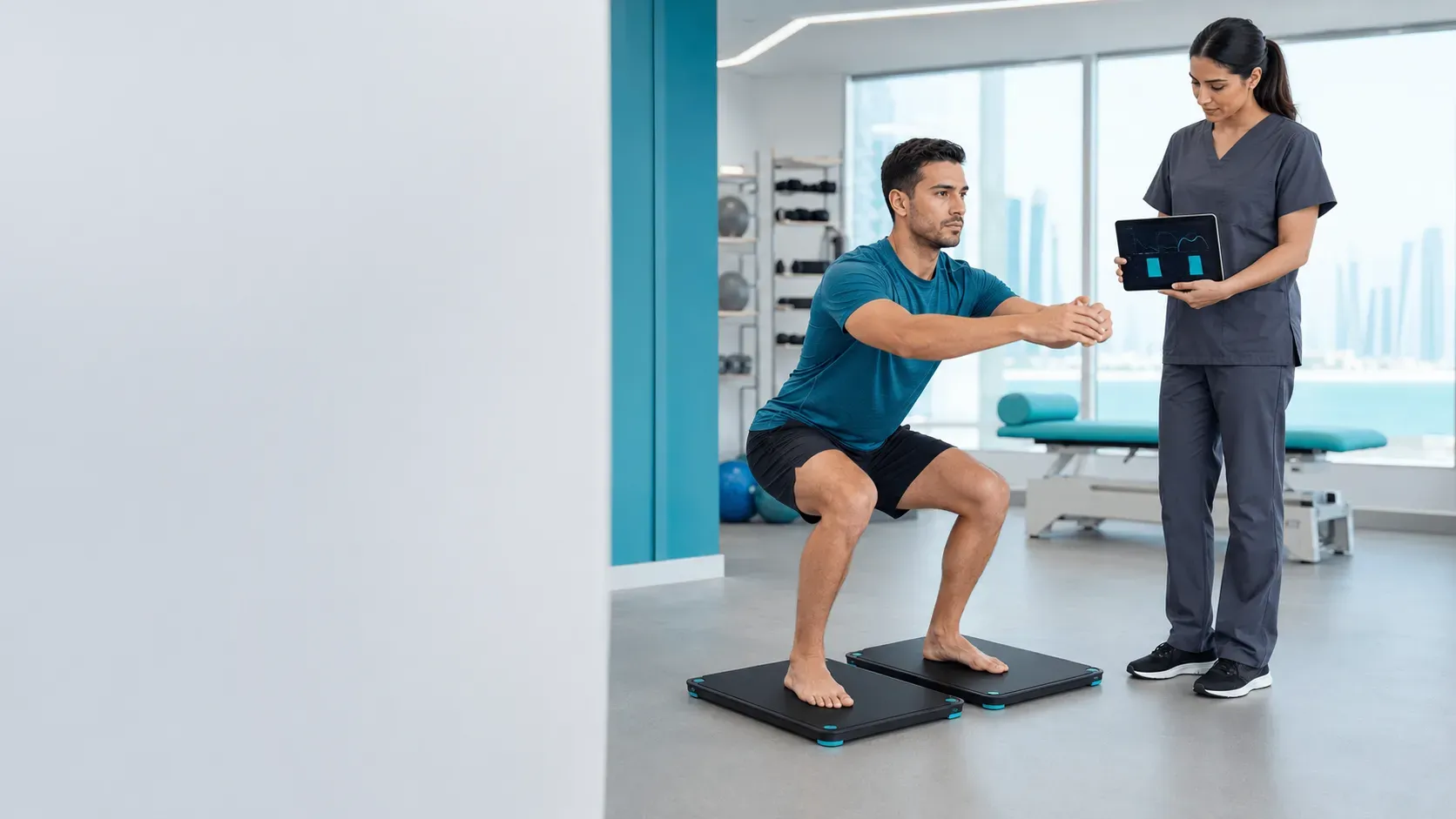
Force Plate Testing in Physiotherapy and Rehabilitation
Force plate testing gives physiotherapists objective information about how a person produces, absorbs and distributes force during movements such as standing, squatting and jumping. It can help identify side-to-side differences, guide rehabilitation exercises and monitor progress, but it should be interpreted alongside a full clinical assessment rather than used as a stand-alone return-to-sport test.
This guide explains how force plates are used in physiotherapy and sports rehabilitation, what the measurements mean, and what patients can expect from force plate testing in Abu Dhabi.
Key takeaways
- A force plate measures the forces applied to the ground during a movement.
- Testing can provide objective data about strength, balance, power, landing strategy and asymmetry.
- The test selected should match the person’s injury, rehabilitation stage and activity goals.
- Results can be repeated over time to monitor change and guide exercise progression.
- Force plate data should support—not replace—clinical assessment, strength testing and sport-specific evaluation.
What is a force plate?
A force plate is a measurement platform that records ground reaction force: the force exchanged between the body and the ground while a person stands or moves. Depending on the system and test, the software can turn this information into clinically useful measures related to force production, balance, jump performance, landing and differences between limbs.
Dual force plates can record the left and right sides separately. This may reveal a movement strategy or loading difference that is difficult to quantify through observation alone. An asymmetry is not automatically an injury, however; it must be considered in context.
What can force plate testing measure?
The available measurements depend on the test and equipment. A physiotherapist may assess:
- Force production: how much force a person generates during a task.
- Rate of force development: how quickly force is produced.
- Power and jump performance: information derived from jumping tasks.
- Landing and force absorption: how force is managed when returning to the ground.
- Left-to-right differences: how load or force is distributed between limbs.
- Balance and postural control: changes in pressure or force while standing.
Not every metric is relevant to every patient. The clinician should select a small number of meaningful measures that relate to the injury, functional difficulty and rehabilitation goal.
How are force plates used in physiotherapy and rehabilitation?
1. Establishing a baseline
Testing can create an objective starting point. For example, a person may appear to squat or jump evenly but place more load through one side. The result can help the physiotherapist decide which movement qualities or physical capacities deserve closer assessment.
2. Guiding exercise selection
Force plate findings may help shape a rehabilitation programme. Depending on the assessment, the clinician might prioritise strength, control, power development, landing practice or confidence with loading. The programme should still be based on the patient’s diagnosis, symptoms, function and goals.
3. Monitoring progress
Repeating the same standardised test can show how selected measures change over time. This gives the clinician and patient another way to review progress alongside pain, range of movement, strength and real-world function.
4. Supporting return-to-sport decisions
For an athlete returning after injury, force plates may contribute information about jumping, landing and limb-loading strategies. They are most useful as one part of a broader assessment that may also include clinical examination, strength measures, hop or agility tests, sport-specific tasks and psychological readiness.
Who may benefit from force plate testing?
A physiotherapist may consider testing for:
- Athletes progressing through lower-limb rehabilitation
- People returning to running, field sports, court sports or gym training
- Rehabilitation following an appropriately diagnosed knee, ankle or lower-limb injury
- Patients working to improve balance or confidence with loading
- Active adults who need objective progress measures
- Athletes establishing performance benchmarks
Force plate testing is not necessary for every patient. A clinician can determine whether it is suitable and whether the chosen test can provide information that will change the rehabilitation plan.
What should you expect during a force plate assessment?
- Clinical discussion: the physiotherapist asks about your symptoms, injury history, activity and goals.
- Safety and movement screening: the clinician checks whether the planned task is appropriate for your current stage.
- Test explanation and warm-up: you are shown the movement and given time to practise where required.
- Standardised testing: you perform selected tasks on the plates, often for several trials.
- Result interpretation: the clinician explains the relevant findings without treating one number as a diagnosis.
- Rehabilitation planning: the results may inform exercises, loading targets and the timing of future reassessment.
Tests can range from quiet standing or an isometric task to squats and different types of jumps. The chosen task should be safe, repeatable and relevant to the patient.
Force plate testing versus visual assessment
| Visual and clinical assessment | Force plate testing |
|---|---|
| Observes movement quality and symptoms | Quantifies forces and timing during selected tasks |
| Provides essential clinical context | Adds objective, repeatable measurements |
| Can identify visible compensation | May detect loading differences that are difficult to see |
| Guides diagnosis and safety decisions within clinical scope | Does not diagnose an injury by itself |
The two approaches work best together. Data without clinical context can be misleading, while observation alone may not quantify subtle changes.
What are the limitations?
Force plates provide measurements, not a complete answer. Results can be affected by the task, instructions, fatigue, confidence, pain and testing protocol. Comparisons between limbs also need care because the uninjured side may have changed during a long rehabilitation period.
Research supports the clinical use of force plate methods, but there is no single test or metric suitable for every injury or sport. A 2023 scoping-review protocol highlighted the need to improve consistency in how tests and variables are selected for injury profiling and rehabilitation. Research following anterior cruciate ligament reconstruction also shows that force plate jump testing can identify differences in neuromuscular function, although interpretation and test selection remain important.
When should testing be delayed?
Testing should be modified or delayed when the required task is not safe—for example, with a new injury, substantial pain or swelling, inability to bear weight, or when jumping has not yet been cleared. Seek prompt medical assessment for severe pain, suspected fracture or dislocation, rapidly increasing swelling, loss of sensation, marked weakness, chest pain or difficulty breathing.
Force plate testing at Perfect Balance in Abu Dhabi
At Perfect Balance Rehabilitation Centre in Reem Island, Abu Dhabi, objective testing may be used within a physiotherapy-led rehabilitation plan when clinically appropriate. Results are considered alongside your history, symptoms, movement, strength and activity goals.
This approach can help the physiotherapist choose relevant exercises, monitor selected measures and support a gradual return to activity. Testing does not guarantee recovery or remove all injury risk, and recommendations vary according to the individual assessment.
Explore physiotherapy at Perfect Balance or our sports injury rehabilitation service. To ask whether force plate testing is appropriate for you, contact Perfect Balance Rehabilitation Centre.
Frequently asked questions
What does a force plate test show?
Depending on the test, a force plate can measure how much force you produce, how quickly you produce it, how you absorb force, how you balance and how loading differs between limbs. A physiotherapist interprets these findings alongside your symptoms, injury history and other clinical tests.
Are force plates only for professional athletes?
No. They may also be useful for recreational athletes and active adults when objective testing will help guide rehabilitation or monitor progress. The decision depends on whether a suitable test is relevant to the person’s condition and goals.
Can force plates tell me whether I am ready to return to sport?
They can contribute useful information, but one force plate score cannot confirm readiness by itself. Return-to-sport decisions should consider healing, symptoms, strength, movement, sport-specific capacity, confidence and the demands of the activity.
Can force plate testing diagnose an injury?
No. Force plates measure performance during selected tasks; they do not independently diagnose the source of pain or tissue damage. Diagnosis requires an appropriate clinical assessment and, where indicated, medical investigation.
Is force plate testing painful?
The platform itself does not cause pain. Some tasks may challenge the recovering area, so the clinician should choose or modify them according to your rehabilitation stage. Report pain, instability or unusual symptoms during the assessment.
How often should testing be repeated?
There is no universal schedule. Reassessment should occur when enough rehabilitation has taken place for a meaningful change to be expected, or when the result will influence the next stage of the plan.
Conclusion
Force plate testing can add objective information to physiotherapy by measuring how a person produces, absorbs and distributes force. When the test is appropriately selected and interpreted, it may help guide exercises, monitor rehabilitation and inform return-to-activity planning. It should always be used as part of a broader clinical assessment.
Would force plate testing support your rehabilitation?
A physiotherapist can assess your symptoms, current capacity and activity goals before deciding whether objective force plate testing is appropriate.
Speak With Our Physiotherapy Team
Perfect Balance Rehabilitation Centre, Reem Island, Abu Dhabi
Medical disclaimer: This article provides general educational information and is not a substitute for individual medical assessment, diagnosis, treatment or emergency care. Seek professional advice for new, severe, worsening or unexplained symptoms.
References