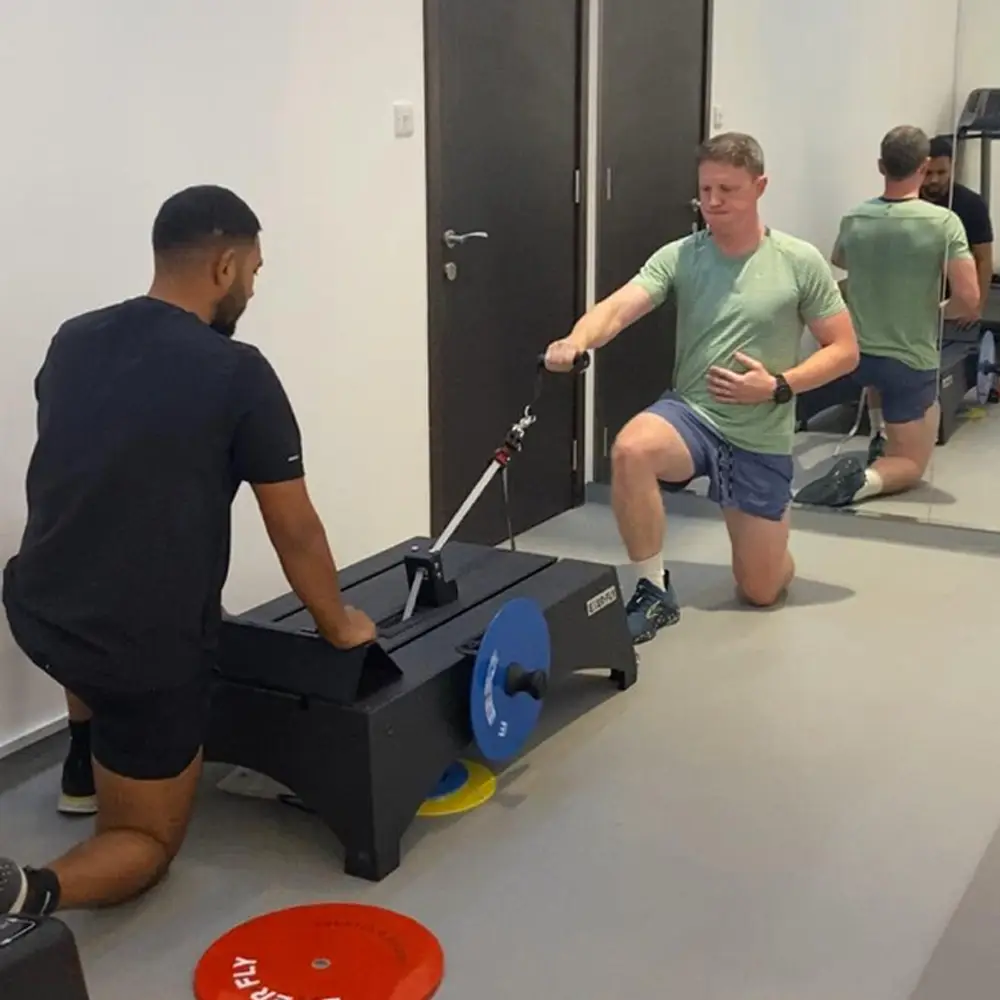
How flywheel training works
How does flywheel training work in rehabilitation? Flywheel training uses a rotating disc rather than a weight stack to create resistance. The patient accelerates the flywheel during the effort phase, then controls the energy as the strap rewinds. A physiotherapist may use this resistance to develop strength, control and power, but the exercise and training dose must match the person’s condition, rehabilitation stage and goals.
This guide explains what flywheel resistance training feels like, how it differs from conventional strength exercise, what current research suggests and what patients can expect when it is used within rehabilitation in Abu Dhabi.
Key takeaways
- Flywheel training creates resistance through rotational inertia rather than gravity-based weights.
- The user produces energy while pulling or pushing, then absorbs that energy while controlling the return phase.
- It can be adapted for strength, movement control, power and activity-specific rehabilitation.
- Flywheel exercise does not automatically create eccentric overload; technique, effort and equipment settings matter.
- It is one training option, not a replacement for clinical assessment or every other form of resistance exercise.
What is flywheel training?
Flywheel training—also called flywheel resistance training or isoinertial training—uses one or more rotating discs connected to a strap or cable. Instead of lifting a fixed weight against gravity, the person moves the strap and causes the disc to spin.
The energy created during the first part of the repetition is stored in the rotating flywheel. As the strap rewinds, the person must slow and control the returning pull. This produces resistance during both the shortening, or concentric, part of the movement and the lengthening, or eccentric, part.
The machine does not select a weight in kilograms in the same way as a conventional gym machine. The resistance experience depends on the flywheel’s moment of inertia, the device, the exercise, movement speed, technique and how much effort the person produces.
How does a flywheel repetition work?
- Starting position: the strap is wound around the flywheel shaft and the patient is positioned for the chosen exercise.
- Acceleration: the patient pushes or pulls, unwinding the strap and making the flywheel rotate.
- Energy storage: the faster or harder the movement, the more rotational energy is created within the limits of the selected inertia and technique.
- Rewinding: the spinning flywheel rewinds the strap and pulls the patient towards the return phase.
- Deceleration: the patient resists and brakes the returning force to finish the repetition under control.
This continuous change between producing and absorbing force can be useful in rehabilitation, particularly when a physiotherapist wants to train controlled deceleration as well as force production.
Does flywheel training always produce eccentric overload?
No. Flywheel exercise includes an eccentric phase, but it does not automatically create eccentric overload. Eccentric overload means that a mechanical measure such as force, velocity or power is higher during the braking phase than during the effort phase.
A 2026 scientific review explains that true eccentric overload depends on factors including technique, movement tempo, joint position, selected inertia, fatigue and training experience. It should not be assumed simply because a flywheel device is being used.
Important distinction: flywheel resistance can train both concentric and eccentric muscle actions. Producing a greater eccentric load requires an appropriate method and, when relevant, measurement—not just the presence of a flywheel.
How may flywheel training be used in rehabilitation?
A physiotherapist may include flywheel exercises when they provide a useful way to work towards a patient’s functional goal. The device is a tool within the rehabilitation plan; it is not a treatment for a diagnosis by itself.
Developing strength
Exercises such as squats, split squats, hip hinges, rows or presses may be performed with a flywheel system, depending on the equipment available. The clinician can select a movement and level of inertia that allow the patient to work through an appropriate range with good control.
Training force absorption and deceleration
The return phase requires the patient to absorb and slow the flywheel’s energy. This may be relevant when rehabilitation is progressing towards tasks that involve braking, landing or changing direction. These higher-demand goals should be introduced only when the person has sufficient capacity and clinical clearance.
Progressing from two limbs to one
Some movements can progress from bilateral to unilateral variations. A one-sided exercise may challenge balance, strength and control differently, but it is not automatically the correct progression for every injury.
Preparing for activity or sport
Later-stage exercises may be selected to reflect the force, speed or direction demands of running, field sports, racket sports or gym training. Transfer is not automatic: the rehabilitation plan may still need jumping, sprinting, agility, endurance and sport-specific practice.
Monitoring exercise output
Some flywheel systems provide measures such as velocity or power. When the device, test and protocol are suitable, these data may help the physiotherapist standardise training or monitor selected changes. Numbers should be interpreted alongside symptoms, movement quality, strength and real-world function.
Flywheel training versus traditional resistance training
| Feature | Flywheel resistance | Traditional resistance |
|---|---|---|
| Source of resistance | Rotational inertia created by a spinning disc | Gravity, weight stacks, free weights, bands or body weight |
| Return phase | The user brakes the energy generated in the preceding effort | The user controls an external load or elastic resistance |
| Loading description | Inertia, effort, speed, technique and output measures | Often described in kilograms, percentage of maximum or band resistance |
| Useful applications | Continuous concentric–eccentric work and braking-focused exercise | Broad strength, endurance, power and functional exercise options |
| Main limitation | Requires familiarisation, suitable equipment and skilled prescription | The resistance profile may not match every movement or training goal |
Neither method is universally better. A 2024 systematic review and meta-analysis in healthy participants found that both flywheel and traditional resistance training can improve maximal strength and muscle power. The most appropriate choice depends on the goal, available equipment, rehabilitation stage, patient preference and clinician judgement.
What does research say about the benefits?
Research supports flywheel training as a valid resistance-training method, particularly in healthy people and athletes. Systematic reviews have reported improvements in outcomes such as strength, power, jumping, sprinting and change-of-direction performance. However, results vary with the population, exercise, programme and comparison group.
The evidence needs careful interpretation for patients:
- Much of the research involves healthy or trained participants rather than people with a specific injury.
- Study programmes differ in exercise choice, inertia, volume, frequency and duration.
- Performance improvements in a study do not prove that flywheel training accelerates healing.
- Research on some injury-prevention programmes—particularly in football—does not establish that flywheel exercise prevents every injury in every sport.
- There is no single flywheel protocol suitable for all rehabilitation conditions.
A 2024 international consensus statement also notes that reliable flywheel outputs depend on the user’s effort, experience, selected inertia and the mechanical characteristics of the device. Familiarisation and consistent technique therefore matter when training or comparing results.
Who may be considered for flywheel exercise?
Following an individual assessment, flywheel training may be considered for:
- Active adults rebuilding lower- or upper-limb strength
- Athletes progressing through sports injury rehabilitation
- People preparing to return to running, field sports, court sports or gym training
- Patients who need to develop controlled force absorption or deceleration
- People completing post-surgical rehabilitation after appropriate clearance
- Older adults when the exercise, support and training dose suit their health and current capacity
Flywheel training is not necessary for every patient. Conventional weights, resistance bands, body-weight exercise, machines and activity-specific practice may be equally or more appropriate at different stages.
When should flywheel training be modified or delayed?
The clinician may modify or delay a flywheel exercise if the movement is not currently safe or if the patient cannot control the return phase. Examples include a new or undiagnosed injury, substantial pain or swelling, loss of function, incomplete post-surgical clearance, poor tolerance of the selected movement or symptoms that worsen with loading.
Flywheel sessions can cause muscle fatigue and delayed-onset muscle soreness, particularly when the braking phase is unfamiliar. More soreness does not mean a better session. The clinician should select an appropriate starting dose, teach the technique and review the person’s response during and after training.
People with a medical condition, recent surgery or uncertainty about exercise safety should obtain appropriate clinical or medical advice before starting. New, severe, worsening or unexplained symptoms require assessment rather than an unsupervised training trial.
What should you expect during a flywheel rehabilitation session?
- Assessment: the physiotherapist reviews your symptoms, diagnosis, health history, current function and goals.
- Exercise selection: a movement is chosen to match the capacity or task being trained.
- Familiarisation: the clinician explains the device, sets the range and allows controlled practice repetitions.
- Technique coaching: you learn how to accelerate smoothly and control the strap as it rewinds.
- Individual dosing: inertia, effort, repetitions, sets, rest and movement speed are selected for your current stage.
- Response monitoring: the clinician observes symptoms, fatigue, control and any available output data.
- Progression: the exercise may change over time as strength, confidence and activity tolerance improve.
You should tell the clinician if you experience sharp or increasing pain, dizziness, loss of control or symptoms that feel different from expected muscular effort.
Flywheel training at Perfect Balance in Abu Dhabi
Perfect Balance Rehabilitation Centre may use flywheel training for rehabilitation as part of an individual physiotherapy programme when clinically appropriate. The clinic is located at Tamouh Tower, Marina Square, Reem Island, Abu Dhabi.
A plan may combine flywheel resistance with conventional strength exercise, mobility work, education and activity- or sport-specific rehabilitation. Patients with a sports-related goal can also explore sports injury rehabilitation at Perfect Balance. Meet Hiten Maisuria, Head of Physiotherapy, or view information about Perfect Balance Rehabilitation Centre.
Frequently asked questions
Is flywheel training suitable for beginners?
It may be suitable when the exercise and training dose match the person’s capacity and the technique is taught carefully. Beginners normally need familiarisation because controlling the rewinding strap feels different from using a conventional weight.
Is flywheel training safer than weights?
No resistance method is automatically safer in every situation. Safety depends on the patient, exercise selection, technique, training dose, equipment and supervision. Flywheel and conventional resistance training can both be adapted appropriately or prescribed poorly.
Can flywheel training speed up injury recovery?
Flywheel exercise may help develop physical capacities required for recovery, but evidence does not support promising faster healing for every injury. Recovery also depends on the diagnosis, tissue healing, symptoms, rehabilitation plan, participation and activity demands.
Does flywheel training prevent sports injuries?
Some sports programmes that included flywheel exercises have reported fewer lower-limb injuries, but this does not prove that the device alone prevents injury. Injury risk is influenced by previous injury, exposure, strength, workload, recovery and many other factors.
Is a higher flywheel inertia always harder?
Not in the same way that adding kilograms makes a conventional weight heavier. Higher inertia usually changes acceleration and movement speed, while lower inertia can allow faster movement. The overall demand also depends on effort, technique, range and the exercise, so settings should be selected for the intended goal.
How often should flywheel training be used?
There is no universal schedule for rehabilitation. Frequency depends on the condition, training goal, total exercise programme, recovery and response to previous sessions. The physiotherapist should adjust the dose rather than applying an athlete research protocol to every patient.
Conclusion
Flywheel training is a versatile form of resistance exercise that challenges a person to produce and then absorb rotational energy. It may support strength, movement control, power and later-stage rehabilitation when the exercise is well selected. It should be used as part of an individual plan, with realistic expectations and appropriate familiarisation—not as a guaranteed shortcut to recovery or performance.
Could flywheel training support your rehabilitation?
A physiotherapist can assess your symptoms, current capacity and activity goals before deciding whether flywheel resistance is appropriate.
Speak With Our Physiotherapy Team
Perfect Balance Rehabilitation Centre, Reem Island, Abu Dhabi
Medical disclaimer: This article provides general educational information and does not replace individual medical assessment, diagnosis, treatment or emergency care. Exercise recommendations vary according to the condition and the patient. Seek appropriate professional advice for new, severe, worsening or unexplained symptoms.
References
- Beato M, et al. Current Guidelines for the Implementation of Flywheel Resistance Training Technology in Sports: A Consensus Statement. Sports Medicine. 2024.
- Spudić D, Nosaka K. Do Flywheel Exercises Provide Eccentric-Overload Training? Sports Medicine – Open. 2026.
- Hu Z, et al. Comparing the Effect of Isoinertial Flywheel Training and Traditional Resistance Training on Maximal Strength and Muscle Power in Healthy People. Life. 2024.
- Buonsenso A, et al. A Systematic Review of Flywheel Training Effectiveness and Application on Sport-Specific Performances. Sports. 2023.
- Čokorilo N, et al. Flywheel Training in Older Adults—A Systematic Review. Sustainability. 2022.