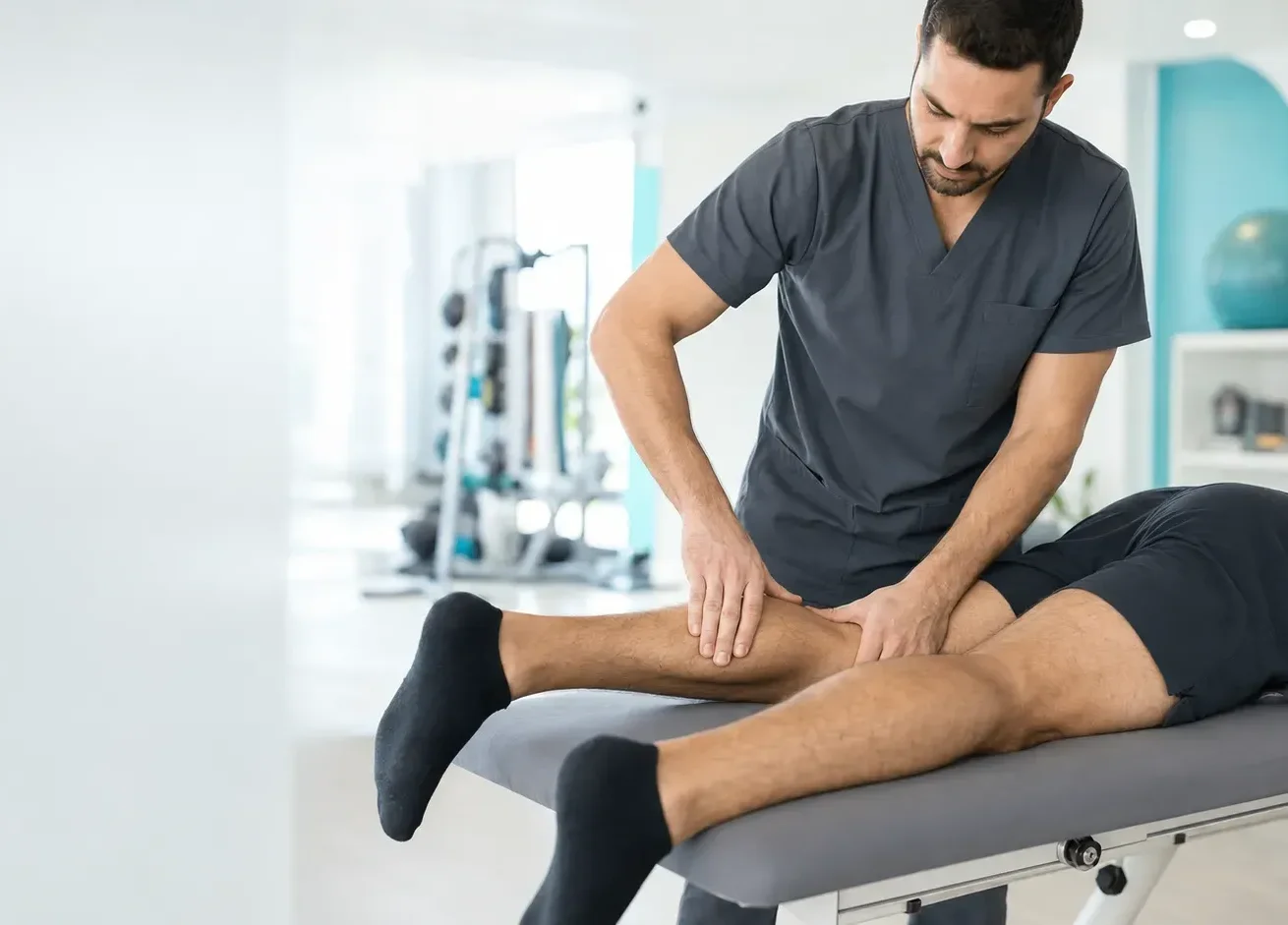
Why Tendon Loading Matters in Tendinopathy Recovery
Why is loading important for tendinopathy recovery? Carefully prescribed tendon-loading exercise may help reduce pain, improve function and rebuild the tendon’s capacity to manage everyday or sporting demands. Complete rest can reduce symptoms temporarily, but it does not prepare the tendon for future load. The right exercise type, intensity and progression depend on the affected tendon, symptoms and individual assessment.
Key takeaways
- Tendinopathy usually causes pain and reduced function when a tendon is loaded.
- Progressive exercise is commonly used to help the tendon and surrounding muscles tolerate load again.
- More load is not always better; the programme should be challenging without causing an unmanageable or sustained flare-up.
- Eccentric exercise is one option, but it is not the only way to load a tendon.
- Recovery time and exercise progression vary, so an individual physiotherapy assessment may be appropriate.
What is tendinopathy?
Tendinopathy is a term used for persistent tendon pain and reduced function, often felt during activities that place demand on the tendon. A tendon is the strong connective tissue that joins muscle to bone and transfers force so that the body can move.
Common examples include Achilles tendinopathy near the ankle, patellar tendinopathy at the knee, rotator cuff-related tendon pain at the shoulder, lateral elbow tendinopathy and gluteal tendinopathy at the side of the hip. These conditions are not identical. The location of the pain, the type of tendon and the person’s activity all influence assessment and rehabilitation.
Tendinopathy is often associated with a mismatch between the load placed on a tendon and its current capacity. A sudden increase in running distance, jumping, gym volume or work activity may contribute, but symptoms can also develop without one clear training error. Age, previous injury, health conditions, recovery and other individual factors may be relevant.
Why does a painful tendon need loading?
A painful tendon needs an appropriate level of loading because recovery is not only about settling symptoms; it is also about restoring the ability to tolerate force. Progressive resistance exercise can challenge the tendon–muscle system in a controlled way and prepare it for daily activity, work or sport.
Too little activity for too long may reduce the capacity of the tendon and surrounding muscles. Returning suddenly to the previous level of activity can then exceed that reduced capacity. Conversely, repeatedly pushing through a substantial flare-up may also be unhelpful. Rehabilitation aims to find a manageable starting point and progress from it.
Current evidence supports exercise-based rehabilitation for common tendinopathies, although no single loading method is best for every tendon or every person. For midportion Achilles tendinopathy, the 2024 clinical practice guideline recommends tendon-loading exercise with loads as high as tolerated as a first-line intervention, performed at least three times per week. That recommendation is specific to midportion Achilles tendinopathy and should not be copied automatically to every condition.
Does tendon loading stimulate healing?
Loading creates mechanical and biological signals within the tendon and surrounding muscle, but patients should be cautious about interpreting this as a simple promise to “heal” or normalise the tendon. Exercise can improve pain, function, strength and load tolerance even when imaging appearance does not change in the same way.
The clinical goal is therefore broader than changing tendon structure. A useful programme considers what the patient needs to do: walk comfortably, climb stairs, lift, run, jump, work overhead or return to a particular sport. Progress should be judged using symptoms and meaningful functional measures, not imaging alone.
What types of tendon-loading exercise may be used?
Tendon loading can include isometric, isotonic, eccentric, heavy-slow resistance and activity-specific exercise. The terms describe how the muscle and tendon are challenged; they are not competing “cures”. A physiotherapist may use more than one type across rehabilitation.
| Loading approach | Plain-language explanation | Possible role |
|---|---|---|
| Isometric | The muscle produces force while the joint position stays relatively still. | May provide an accessible starting option when movement is sensitive, but pain response varies. |
| Isotonic | The muscle works while the joint moves through a range. | Builds strength and movement capacity through controlled repetitions. |
| Eccentric | The muscle–tendon unit lengthens while producing force. | A recognised option, but not necessarily superior to all progressive loading programmes. |
| Heavy-slow resistance | Resistance is increased gradually while movements are performed at a controlled speed. | May develop strength and tendon-loading capacity when appropriate. |
| Energy-storage and sport-specific | Faster tasks such as hopping, jumping, changing direction or throwing. | Prepares the tendon for higher-speed demands later in rehabilitation. |
Is eccentric exercise the best treatment for tendinopathy?
Eccentric exercise can be effective, but it is not the only evidence-based approach and is not automatically best for everyone. Research in patellar tendinopathy has shown that a staged progressive tendon-loading programme can produce better clinical outcomes than a pain-provoking eccentric programme in some patients.
A 2023 systematic review across common tendinopathies also found that resistance exercise outcomes may be influenced by programme dose and recovery time. However, the available studies vary considerably, and an ideal universal prescription has not been established. Exercise selection should be based on the tendon involved, current capacity, symptoms, equipment, goals and ability to follow the programme.
How is tendon load progressed safely?
Load is usually progressed by changing resistance, repetitions, range, speed, frequency or task complexity. Progression should be based on the patient’s response rather than a fixed calendar alone.
- Establish a baseline. Identify which activities provoke symptoms and measure current strength and function.
- Choose a tolerable starting exercise. Select a load and movement that the patient can perform with suitable technique.
- Monitor the response. Record discomfort during exercise and how symptoms behave later that day and the following morning.
- Progress one factor at a time. Increase resistance, volume, range or speed according to the response.
- Prepare for real demands. Add faster, heavier or activity-specific tasks when the patient has sufficient capacity.
- Review meaningful function. Test the activities that matter to the patient rather than relying on pain alone.
Some rehabilitation programmes allow a degree of tolerable discomfort, but there is no single pain number that is safe for every person or tendon. A more useful question is whether symptoms remain manageable and return towards their usual level after exercise. Persistent escalation, loss of function or a marked next-day response may indicate that the programme needs adjustment.
Important: Do not copy a generic online loading programme when the diagnosis is uncertain, after a sudden injury, or when symptoms are worsening. The correct exercise for an Achilles tendon may not suit a shoulder, hip, elbow or patellar tendon.
Should you rest a painful tendon completely?
Complete rest is not routinely the long-term solution for tendinopathy. Short-term activity modification may be useful when normal activity is causing repeated flare-ups, but the aim is normally to retain tolerable movement and rebuild capacity progressively.
Activity modification does not always mean stopping sport. Depending on the assessment, a runner might temporarily reduce speed, hills or weekly distance; a gym user might change the exercise range or resistance; and someone with shoulder symptoms might modify repeated overhead work. The plan should preserve useful activity while reducing the specific demand that the tendon cannot currently tolerate.
How long does tendon rehabilitation take?
There is no reliable universal recovery time. Symptoms may improve gradually over weeks or months, and progress can be affected by how long the problem has been present, the tendon involved, activity demands, general health, adherence and appropriate load progression.
A slower week does not automatically mean that the tendon has been damaged again. Tendon symptoms can fluctuate. A physiotherapist can reassess the programme when pain, function or activity tolerance is not improving as expected.
What happens during a physiotherapy assessment?
A physiotherapy assessment for suspected tendinopathy should first clarify whether the presentation is consistent with a tendon problem and whether another condition or medical referral needs consideration.
The appointment may include:
- How the symptoms started and which loads provoke them
- Training, work and recent changes in activity
- Relevant health history, medication and previous injuries
- Movement, strength and tendon-loading tests
- Functional tasks related to daily life or sport
- A starting exercise programme and load-management plan
- Measures that can be repeated to track progress
Imaging is not required for every case. Whether ultrasound, MRI or another investigation is appropriate depends on the clinical findings and whether the result is likely to change management.
When should tendon pain be medically assessed?
Arrange an appropriate clinical assessment if pain is persistent, worsening, repeatedly returning or limiting normal activity. Seek urgent medical attention after a sudden injury with a snap or pop, an obvious change in shape, severe swelling, an inability to use the limb normally, or suspected tendon rupture.
Prompt medical advice may also be appropriate when pain is accompanied by fever, a hot and markedly swollen joint, unexplained numbness or weakness, significant trauma, or other symptoms that concern you. This list is not a diagnosis or a complete emergency guide.
Tendon-loading physiotherapy at Perfect Balance in Abu Dhabi
Perfect Balance Rehabilitation Centre provides physiotherapy in Abu Dhabi for people experiencing pain, injury or difficulty returning to activity. For sport-related problems, the clinic also provides sports injury rehabilitation at Tamouh Tower, Marina Square, Reem Island.
Depending on the assessment, a rehabilitation plan may include education, activity modification, progressive strength work and task-specific exercises. The aim is to match the programme to the affected tendon, current capacity and personal goals.
Frequently asked questions
Can loading make tendinopathy worse?
An inappropriate dose can aggravate symptoms, but this does not mean all loading should stop. The exercise type and dose may need to be reduced or changed. Sudden severe pain or loss of function requires assessment rather than continued exercise.
Should tendon exercises hurt?
Some programmes permit mild, tolerable discomfort, while others begin with pain-minimised exercise. The acceptable response depends on the condition and the individual. Symptoms should be monitored during exercise and afterwards, rather than using pain as the only measure of progress.
How often should I load a tendon?
Frequency varies with the tendon, exercise intensity, stage of rehabilitation and recovery response. For example, a guideline for midportion Achilles tendinopathy recommends tendon-loading exercise at least three times per week, but that recommendation should not be applied automatically to all tendinopathies.
Are isometric exercises enough?
Isometric exercise may be useful at some stages, but rehabilitation often needs to progress towards moving resistance and the specific demands of work, daily life or sport. The appropriate sequence depends on assessment.
Do I need a scan before starting rehabilitation?
Not everyone needs imaging. Tendinopathy is often assessed clinically. Imaging may be considered when the diagnosis is unclear, a significant tear is suspected or the findings would change management.
Can massage, shockwave or dry needling replace loading exercise?
Passive treatments may sometimes be considered as adjuncts, but they do not rebuild strength and activity tolerance by themselves. Their suitability and evidence vary by condition. Exercise-based rehabilitation usually remains central for common tendinopathies.
References
- Chimenti RL, et al. Achilles Pain, Stiffness, and Muscle Power Deficits: Midportion Achilles Tendinopathy—Revision 2024. Journal of Orthopaedic & Sports Physical Therapy. 2024.
- Breda SJ, et al. Effectiveness of progressive tendon-loading exercise therapy in patients with patellar tendinopathy. British Journal of Sports Medicine. 2021.
- Pavlova AV, et al. Effect of resistance exercise dose components for tendinopathy management. British Journal of Sports Medicine. 2023.
- Cardoso TB, et al. Exercise therapy for tendinopathy: a mixed-methods evidence synthesis. British Journal of Sports Medicine. 2023.
Need help planning your tendon rehabilitation?
A physiotherapist can assess your symptoms, current capacity and activity goals before recommending an individual loading programme.
Book a Physiotherapy Assessment
Perfect Balance Rehabilitation Centre, Reem Island, Abu Dhabi
Medical disclaimer: This article provides general educational information and does not replace individual assessment, diagnosis, treatment or emergency medical care. Exercise recommendations vary according to the condition and the patient. Seek appropriate professional advice for new, severe, worsening or unexplained symptoms.